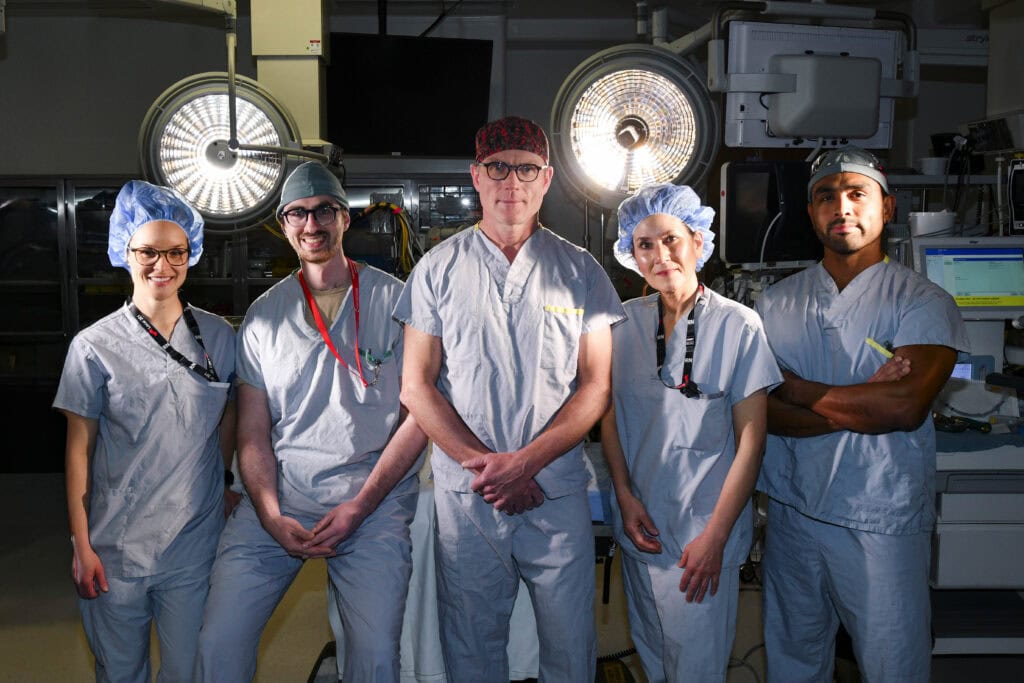
Every year at the University of Alberta Hospital, between 20 to 35 people receive a new heart.
Some are children. Some are adults who were born with complex heart defects and have already survived multiple surgeries. For many, every option has been tried — except one.
In Edmonton, the team led by cardiac surgeon Dr. Steven Meyer and cardiologist Dr. Daniel Kim runs the heart transplant program that gives those patients a second chance at life. Nearly four decades after the first transplant was performed here, it remains one of the most advanced programs in the country — powered in no small part by donor support through the University Hospital Foundation.
“The patients who come to us have reached the final stage of heart failure,” says Dr. Meyer. “All other treatments have been exhausted.”
The reasons vary — infection, inflammation, coronary artery disease, congenital heart conditions or hearts that have simply stretched and weakened beyond repair. A growing number of patients were born with heart defects repaired in childhood. Thanks to pioneering pediatric surgery, they’ve lived into adulthood — but now their hearts are failing, and transplant is their last hope.
The University of Alberta Hospital is the heart transplant centre for Alberta, Saskatchewan and Manitoba — a catchment area of five million square kilometres. “We work closely with our colleagues in Calgary, Saskatoon, Regina and Winnipeg,” explains Dr. Meyer. “They do the assessments and long-term follow-up, and we do the surgeries and early recovery care here in Edmonton.”
Each transplant involves an entire network of professionals including cardiologists, physiotherapists, dietitians, social workers and psychologists. After surgery, patients recover in the Cardiovascular Intensive Care Unit before moving to the ward and, eventually, back home or to their local hospitals.
For patients waiting months, sometimes years for a donor heart, time can run out. Mechanical hearts, such as the HeartMate 3, offer a bridge to survival. These advanced devices pump blood through the body, allowing patients to regain energy and stability while waiting for transplant.
“They’re lifesaving,” says Dr. Meyer, “but they’re also incredibly expensive and complex to manage. When it comes time for transplant, removing them adds another layer of difficulty to the surgery. Still, for many patients, they’re the only reason they live long enough to get a new heart.”
Even as the program saves lives today, the team is pushing toward new frontiers. One groundbreaking initiative is the development of combined heart-liver transplants, a procedure designed for patients whose unique congenital heart circulation has caused both heart and liver failure.
“This will be one of the first programs of its kind in Canada,” says Dr. Meyer. “We’ve secured funding to support the liver while the heart is being implanted — a crucial step that makes the surgery feasible.”
Another bold step forward involves donation after cardiac death (DCD). Traditionally, heart donors are declared brain-dead, but in recent years, a new process has emerged allowing hearts to be recovered from donors after their heart stops. To do so, the donor heart must be resuscitated in an advanced “ex vivo” perfusion system, essentially a machine that keeps the heart beating and nourished outside the body until transplant.
“This technology could increase the number of heart transplants by 20 percent or more,” says Dr. Meyer. “Some centres in the U.S. have doubled their transplant volumes by adopting it. But the challenge is cost. The perfusion system alone is about $250,000, and each use costs around $100,000.”
That’s where donor generosity can once again change everything. With support from the University Hospital Foundation community, Edmonton could become one of Canada’s first centres capable of performing DCD heart transplants, expanding access, saving more lives and offering hope to families across the Prairies.
“When you meet these donor families,” says Dr. Meyer, “you realize how meaningful it is for them. In the midst of tragedy, they find healing through giving. Being able to offer that gift, to help their loved one’s heart beat on, is profoundly powerful.”
Every breakthrough in Alberta’s transplant story, every life restored, every heart that beats again, has been made possible through philanthropy. Donors fund the technology, infrastructure and research that push the boundaries of what’s possible.
“Philanthropy is how ideas become reality,” says Dr. Meyer. “When donors step forward, they’re not just funding machines or research. They’re giving people a second chance at life.”
For patients across the Prairies, that second chance is not just a dream — it’s a heartbeat, restored through science, compassion and the power of generosity.
You can help the University Hospital Foundation’s work by donating online, or purchasing tickets to the Full House Lottery, available now. The loyalty deadline is midnight on February 25, 2026!